By Tim Polidori
Head of Construction, Focus Green · MSc in Building Surveying · MCIOB · NDEA
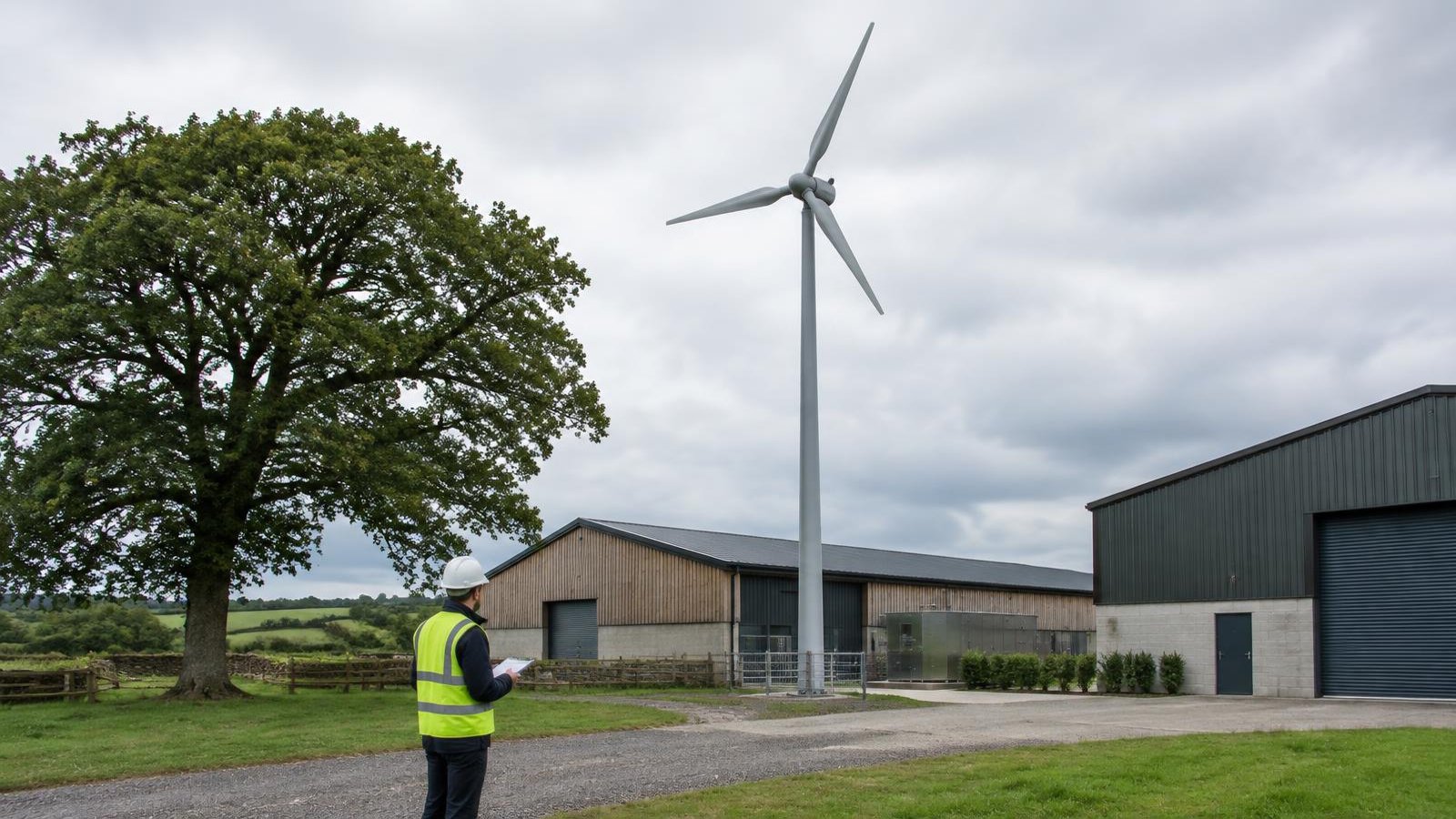
The Government's proposed new permitted development right for small-scale, non-domestic onshore wind, widely known as the Oak Tree Rule, could open up thousands of commercial, agricultural and industrial sites in England to on-site wind generation without a full planning application. Most commentary has focused on height and buffer distances. The condition that may matter most commercially has received far less attention: certification.
Under the consultation proposals, a qualifying turbine would need to be certified to the Microgeneration Certification Scheme (MCS) or an equivalent standard. If that condition survives into the final legislation, the number of eligible turbine models on the market, not just planning, becomes the limiting factor.
What the Oak Tree Rule proposes
The consultation, run by the Department for Energy Security and Net Zero from 18 March to 10 June 2026, proposes a permitted development right for small-scale turbines in non-domestic settings such as commercial premises, farms and industrial sites. Small-scale is defined as a maximum tip height of 30 metres, roughly the height of a mature oak tree, and a swept area of no more than 200 square metres.
The consultation states that a turbine of this size is likely to have a capacity of up to around 50kW. That figure is an indication, not a proposed cap: the proposed limits are physical (tip height and swept area). The proposal is broadly for a single standalone turbine per site, with conditions including a buffer distance of tip height plus 10% from the boundary, exclusions for certain protected sites, non-reflective blade finishes and removal when no longer in use.
The Government has not yet published its response. Nothing is law until a statutory instrument amends the General Permitted Development Order, and any of these details could change. Our Oak Tree Rule policy tracker records the latest status.
The MCS condition: the real bottleneck
The consultation proposes that installations under the new right would need to be certified to MCS or an equivalent standard, to ensure safety and performance. It points to MCS 006 as the small wind turbine product standard, MIS 3003 for installation, and MCS 020(b) for the noise calculation requirements, which align with the international IEC 61400 standards for small turbines. The Government says it is minded to accept equivalent high-quality certification, and asked consultees which schemes should count.
In practice this creates two tests. The turbine model itself needs product certification, and the installation must be carried out and assessed to the relevant installation and noise standards. A site that is otherwise perfect, with good wind and generous boundaries, could still fall outside permitted development simply because the preferred turbine model lacks the right certification.
Certification also matters for revenue. Smart Export Guarantee (SEG) payments for exported electricity generally require installations up to 50kW to be MCS certified (or equivalent). For a site owner, an uncertified turbine could mean a full planning application and no SEG income, which undermines the business case for many sub-50kW schemes.
Why a certification rush is likely
The UK small wind market has been thin for years. The consultation itself notes only 31 MCS-certified domestic wind installations in England since January 2009 under the existing householder rights. With planning slow, uncertain and expensive for small turbines, many manufacturers of 15kW to 50kW machines had little reason to invest in UK certification.
Product certification for small wind is not cheap. It typically involves independent power performance, acoustic and duration testing, design evaluation and factory quality checks. Industry costs are often quoted in the tens of thousands of pounds and, for larger small-wind models, potentially £50,000 to £100,000 or more, alongside many months of testing. Those figures are indicative and vary by model and test route.
If a permitted development right arrives with an MCS-or-equivalent condition, that calculation changes overnight. A realistic route to market across thousands of commercial and agricultural sites would justify the investment, and manufacturers who held back are likely to move at the same time. Test site capacity, certification body resources and accredited installer numbers are all finite, so a queue is a reasonable expectation.
What it means for commercial site owners
If demand for certified turbines rises sharply, lead times for equipment, installers and grid connections will follow. Site owners who complete their groundwork early will be first in the queue once the rules are confirmed.
Useful early steps include: an initial wind resource and siting review; checking boundary distances against the proposed tip height plus 10% buffer; identifying nearby homes and running preliminary noise assessments; checking for exclusions such as protected sites; and confirming grid headroom and export capacity with the distribution network operator. Our free wind feasibility checker gives a quick Red/Amber/Green first view.
Owners should also check that any turbine they shortlist holds, or has a credible timetable for, MCS product certification, and that the installer is MCS certified for small wind. Agreeing equipment before certification is confirmed carries real risk.
What it means for turbine manufacturers
For OEMs and distributors of turbines in the 15kW to 50kW class, the window between the Government response and the statutory instrument may be the most important commercial period in years. Products already certified, or well into testing, would be immediately eligible. Products that are not would be pushed back into the planning system while competitors install.
Early movers can establish installer partnerships, reference sites and evidence of real-world output while the market forms. Late entrants may find test slots booked and buyers already committed. Manufacturers should check whether the final rules accept any 'equivalent' certification and what evidence that would require, rather than assuming it will be a shortcut.
Key takeaway: prepare before the statutory instrument
The Oak Tree Rule is still a proposal, and the final conditions may differ. But the direction is clear enough to act on. Commercial landlords, farmers and asset managers should screen their portfolios now for wind-suitable sites, boundary clearances, noise sensitivities and grid capacity. Manufacturers should assess their certification pipeline before the rush begins.
We help commercial owners and estates assess wind viability ahead of the final rules. Contact us to discuss a portfolio screening, or start with the wind feasibility checker. General guidance only; the final legislation and site-specific assessment will determine eligibility.
Frequently asked questions
- Is the Oak Tree Rule law yet?
- No. It is a consultation proposal. The Government has not yet published its response, and a statutory instrument amending the General Permitted Development Order would be needed before it takes effect.
- Is there a 50kW limit?
- The proposed limits are a 30 metre tip height and a 200 square metre swept area. The consultation says turbines of this size are likely to be up to around 50kW, but that is an indication rather than a proposed capacity cap.
- Does a turbine have to be MCS certified to use the new right?
- Under the consultation proposals, installations would need to be certified to MCS or an equivalent standard. The final rules may define what counts as equivalent.
- Do I need MCS certification to receive Smart Export Guarantee payments?
- SEG licensees generally require installations up to 50kW to be MCS certified or equivalent. Check your chosen supplier's eligibility terms before you buy equipment.
- What should site owners do now?
- Carry out early feasibility work: wind resource, boundary buffers, noise to nearby homes, site exclusions and grid capacity, and shortlist only turbines with MCS certification or a credible route to it.
Source: GOV.UK — Permitted development rights for onshore wind turbines in England: consultation document